Tesla did not get paid for launching a robotaxi. Uber got charged for it. The consensus reading of 3 September is that the Cybercab going into commercial service in Austin repriced both stocks in opposite directions, and for one session it did. Then check the closes. Tesla finished 15 September at $356.58, forty-three cents below its $357.01 close on 2 September, the last session before Cybercab fares started. The whole 5.4% launch-day pop has gone. Uber’s move has not gone anywhere: it closed at $71.43 against $76.45 on 2 September, down 6.57% and staying there, according to Nasdaq daily closes retrieved on 16 September 2026.
The asymmetry stops being strange once you notice the two stocks are not priced on the same object. Tesla is priced on owning the asset. Uber is priced on owning the demand. Push both through the filings and the gap is bigger than the narrative suggests. Uber’s Mobility gross bookings in the second quarter were $28.99bn, about 2.7% more dollars than Tesla’s entire company revenue of $28.24bn, and Uber moved that flow on $135m of capital expenditure across the whole of the first half of 2026 against Tesla’s $8.28bn. Sixty-one times the capital, for the smaller dollar flow. Those two business models converge only if autonomy commoditises the vehicle so thoroughly that owning one stops being a penalty. Neither 10-Q contains evidence that it has.
Key facts
- Tesla closed at $356.58 on 15 September, 0.12% below its pre-launch 2 September close of $357.01 — Nasdaq, retrieved 16 September 2026
- Uber closed at $71.43, down 6.57% from its pre-launch close and 27.7% over 12 months — Nasdaq, retrieved 16 September 2026
- Uber Q2 2026 Mobility gross bookings $28.99bn; Mobility revenue $7.36bn, a 25.4% take rate — Uber 10-Q, filed 5 August 2026
- Uber first-half capital expenditure $135m; Tesla first-half capital expenditure $8.28bn — Tesla 10-Q, filed 23 July 2026
- Tesla total automotive gross margin fell to 16.9% from 17.2% year on year; regulatory credits dropped 67% to $146m — Tesla 10-Q, 23 July 2026
- Texas records showed about 45 Cybercabs registered to the Robotaxi fleet in early September, out of roughly 420 Tesla autonomous vehicles — Motor1, 4 September 2026
- Polymarket prices “Tesla sells a Cybercab for $30k or less in 2026” at 10.5 cents on $56,156 of volume — Polymarket, read 16 September 2026
Two launches, one date, completely different products
Both companies switched something on for paying passengers on 3 September 2026. That is where the similarity ends, and the failure to say so is the core error running through most of the coverage.
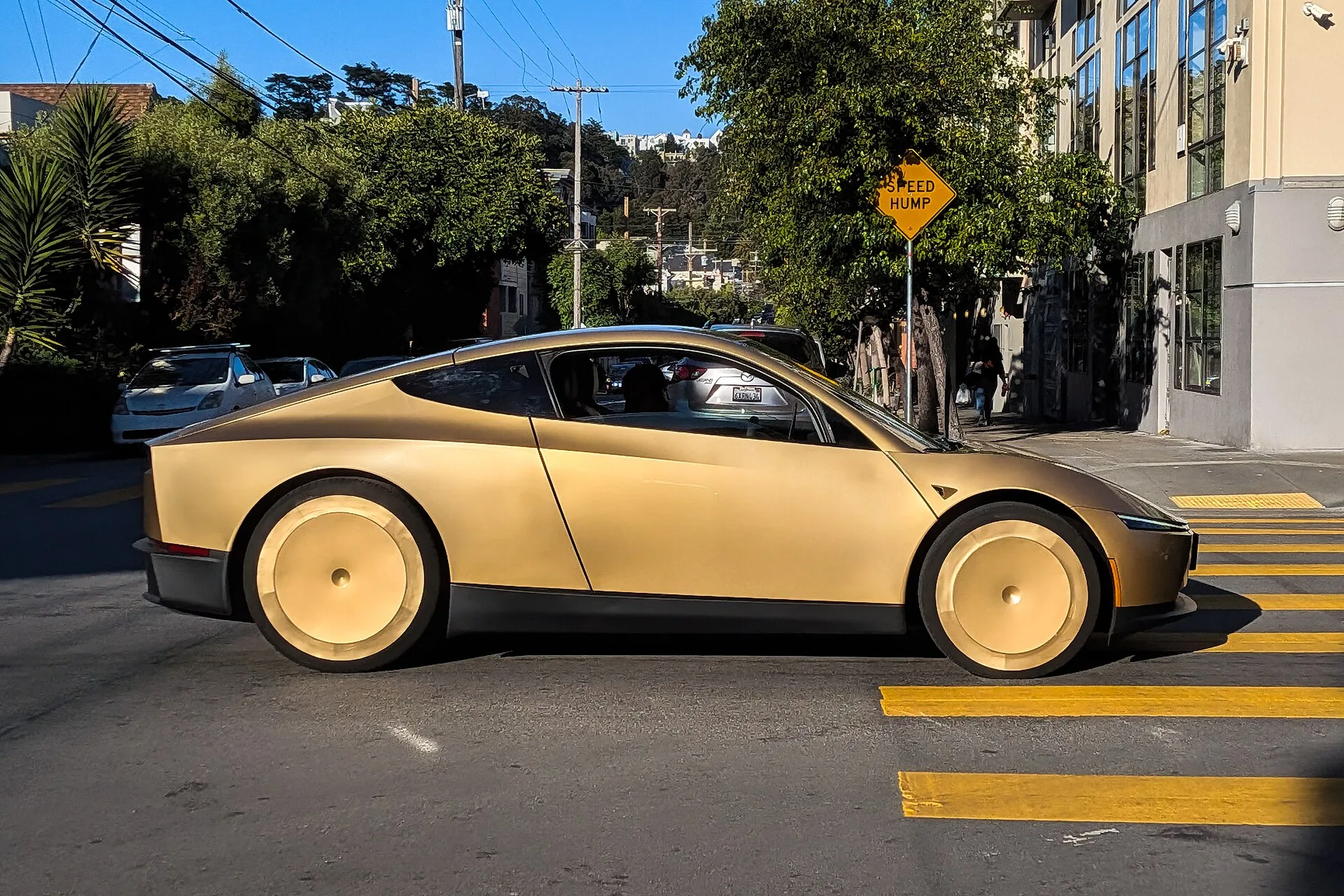
Tesla began charging fares in a limited Austin service area for a two-seat vehicle with no steering wheel, no pedals and no mirrors, dispatched through its existing Robotaxi app. Uber, the same day, put a handful of Ford Mustang Mach-E cars running Wayve’s software onto London streets, each one carrying a Transport for London-licensed private hire driver in the driver’s seat, ready to take over. Reuters reported on 3 September that fewer than 20 cars would be available at launch. Riders requesting an UberX, Uber Comfort or Uber Electric can be matched to one at no extra charge.
Grade both against the only yardstick that matters commercially — paid miles completed with no human in the driver’s seat — and the two events sit in different categories entirely. Tesla’s number is small and real. Uber’s London number is zero, by design, because full driverless operation in Britain needs a separate permitting route through the Driver and Vehicle Standards Agency that Uber and Wayve have not yet cleared. Calling both “robotaxi launches” flattens the single variable that decides whether the unit economics work at all. A supervised autonomous vehicle is a normal minicab with expensive hardware bolted on. It does not remove the labour cost, which is the entire point of the exercise.
Waymo remains the scale reference for anyone doing this arithmetic honestly. In a year-in-review post published on 10 December 2025, the Alphabet subsidiary said it had served “over 14 million trips so far in 2025 alone” and had begun serving over a million fully autonomous rides every month, “a number that we’re on a path to hit every week by the end of 2026.” Tesla’s Austin fleet, at roughly 45 Cybercabs, is not in that conversation yet. Neither is Uber’s London fleet. Our earlier reporting on Nevada lifting Tesla’s robotaxi cap from 10 cars to 5,000 covered the permitting ceiling; the binding constraint since then has been vehicles on the road, not permits on paper.
What each company actually did about it
Tesla’s move at the Austin event went almost unremarked, and it is the most informative thing that happened all month. It landed in a year when the equity story has leaned hard on products that are not yet shipping, from the robotaxi network to the Roadster due on 1 October. Alongside the launch, the company began circulating an interest form to businesses for “Cybercab fleet vehicle purchasing” — buy the cars, run them on Tesla’s network, split the revenue.
Uber went the other way, and went there loudly. Rather than racing to own vehicles, it kept buying supply it does not have to capitalise: Waymo cars dispatch through the Uber app in Austin, Atlanta and Phoenix, and the Wayve deal puts a third party’s hardware and a third party’s driver on the road in London while Uber keeps the rider relationship. The London launch was announced through Uber’s own investor newsroom rather than a product blog, which tells you who the message was aimed at.
Sarfraz Maredia, Global Head of Autonomous Mobility and Delivery at Uber, framed it as expansion rather than substitution in the 3 September release: “London is a world-class hub for transportation innovation and this launch is a major milestone in scaling safe, accessible AV technology in a city with some of the world’s most complex roads.” Alex Kendall, chief executive and co-founder of Wayve, added that “autonomous driving technology will complement the city’s rich transport network.” Complement, not replace. Neither sentence commits Uber to a dollar of vehicle capex.
The bear case on Tesla’s fleet-sales pitch arrived four days later and was blunt. “If a Cybercab on that network genuinely printed $30,000 a year, why would Tesla hand that money to a stranger instead of keeping every car for itself? Companies don’t outsource money machines. They outsource risk,” wrote Fred Lambert, editor-in-chief at Electrek, in a 7 September piece that picked up 82 comments on Hacker News. His precedent is specific rather than rhetorical: MisterGreen, a Dutch leasing firm that bought more than 4,000 Teslas on the promise of network income, went bankrupt in December 2025 and wiped out roughly $40m of bondholder money.
The arithmetic nobody publishes
Here is the fleet maths, with every assumption stated so it can be argued with.
Suppose a robotaxi books ten paid hours a day, every day, at $30 of fare per paid hour. That is generous: the car also has to charge, get cleaned, sit in a depot and deadhead between rides. It grosses $109,500 a year. To replace Uber’s Q2 Mobility gross bookings run-rate of $115.9bn annualised, you would need roughly 1.06 million such vehicles. At $30,000 a unit, that is $31.8bn of vehicle capital before a single depot, charger, insurance policy, cleaning contract or remote-supervision desk. Uber’s annualised capital expenditure, doubling its disclosed first-half figure, is $270m. The ratio is about 118 to one.
Now combine that with something in Tesla’s own filing that nobody has connected to it. Operational Milestone 4 of the 2025 CEO Performance Award, set out in the 10-Q filed on 23 July 2026, is “1 million Robotaxis in commercial operation.” Tesla’s compensation committee and this back-of-envelope calculation have independently landed on the same order of magnitude for what it takes to be one Uber. The difference is that Tesla has to buy the million cars and Uber never did. At current prices, that fleet alone would absorb close to two full years of Tesla’s entire capital budget.
Per mile, the picture is the same. A $30,000 vehicle depreciated over four years while covering 73,000 paid miles a year carries about $0.10 per mile of depreciation on its own, before electricity, insurance, tyres, cleaning or remote supervision. Tesla’s own 10-Q lists the stack it now has to fund alongside the fleet: “vehicle cleaning and maintenance, charging, security, teleoperations and fleet management.” Uber’s cost for that same mile is zero, because the driver bought the car and pays to keep it running.
| Common yardstick, Q2 2026 | Tesla (owns the asset) | Uber (owns the demand) |
|---|---|---|
| Gross dollar flow through the model | $28.24bn total revenue | $28.99bn Mobility gross bookings |
| Share of that flow the company keeps | 100%, minus all operating cost | 25.4% take rate, zero vehicle cost |
| H1 2026 capital expenditure | $8.28bn | $135m |
| H1 operating cash less capex | $350m | $5.08bn free cash flow |
| Margin on the core business | 16.9% automotive gross margin | 30.1% Mobility segment operating margin |
| Market capitalisation | $1.41tn | $146.1bn |
Read the fourth row twice. In the same six months, a company worth a tenth as much converted 14.5 times more cash after capital spending. Tesla’s operating cash flow of $8.63bn was almost entirely consumed by the $8.28bn it spent on plant, tooling and AI compute. That is what vertical integration costs while it is being built, and it is exactly the cost Uber has declined to pay for eleven years. Our coverage of the July selloff in AI capital spending showed the market already has form in punishing this pattern.
Where the rules bite, and who they favour
Regulators reached both companies within hours of the same launch, from opposite directions.
The National Highway Traffic Safety Administration opened Audit Query AQ26002, “Tesla Cybercab FMVSS Certification”, at 19:42 UTC on 3 September, hours after fares started, as Motor1 reported. The Office of Defects Investigation filing notes that the vehicles “lack permanently attached, conventional manual controls, such as a brake pedal, gas pedal, steering wheel, and mirrors” and says it will “consider the extent to which Tesla’s certification depended on determinations that certain FMVSS are inapplicable to the Cybercab.” The question is not how well the car drives. It is whether the self-certification was properly done, and a negative finding would be a paperwork problem with a physical consequence, because the affected vehicles cannot have controls retrofitted. Tesla is separately defending a securities class action in the Western District of Texas alleging misrepresentations about Autopilot, Full Self-Driving and Robotaxi, with a motion to dismiss filed on 20 April 2026 and still live per the 10-Q.
Uber’s regulatory play is stranger and far more revealing. According to a Financial Times report on 3 September, the company has allied with rideshare and taxi driver unions to slow autonomous rollouts: it backed a New Jersey proposal requiring a human driver behind the wheel on at least 85% of robotaxi trips and signed on to a bill barring autonomous vehicles from Washington DC roads, as Gizmodo summarised on 3 September 2026. Manny Pastreich, president of the New York service workers’ union 32BJ SEIU, told the FT the alliance had helped delay the next stage of rollout while adding that the union was not counting on Uber’s support outlasting its usefulness. Drivers are pushing their own version in Atlanta, where the rideshare union wants a robotaxi impact fee of $0.50 to $1 a ride paid into a transition fund.
Work out who an 85% human-driver rule protects. Not drivers, in the long run. It protects the marketplace, because a pure-play autonomous operator with no human supply cannot satisfy it, while Uber can satisfy it out of the driver base it already has. Uber is hedging in both directions simultaneously, buying autonomous supply in London and Austin while lobbying to slow it in New Jersey and Washington. Britain adds a third layer: Transport for London licenses the human in the Wayve cars, and the DVSA controls the permit that would remove them.
One filed cost deserves a mention because it cuts against the asset-light story. Uber has paid His Majesty’s Revenue and Customs roughly $1.8bn (£1.4bn) in disputed VAT assessments for March 2022 to September 2024, booked as a receivable pending appeal. Marketplaces are not free of regulatory capital calls. They just get them in tax rather than in tooling.
What to watch next
Three things will settle this argument faster than any analyst note.
First, the Q3 filings due in late October. Tesla’s “services and other” line grew 50% year on year to $4.58bn in Q2 but bundles robotaxi fares with servicing, Supercharging, insurance and used cars. Until robotaxi revenue gets its own line, treat any per-vehicle economics circulating publicly as unaudited. A separate disclosure would itself be the bullish signal, because companies break out segments they want measured.
Second, the Polymarket contract. “Will Tesla sell a Cybercab for 30k or less in 2026?” trades at 10.5 cents with $56,156 of lifetime volume and under $3,000 of resting liquidity as of 16 September, resolving 31 December. A $30,000 figure gets repeated constantly in Cybercab coverage; the only venue where anyone has money riding on it says there is roughly a one-in-ten chance Tesla actually sells one at that price this year. If a sub-$30,000 configurator price appears, that contract reprices toward one within hours and the fleet-buyer pitch gets its first honest test. If it does not, the $30,000 number is marketing.
Third, AQ26002 and the state bills. An adverse NHTSA finding constrains Cybercab deployment directly. An 85% human-driver rule passing anywhere is a direct transfer to Uber, and it would show up in Mobility take rate before it shows up in the share price. Readers weighing entry points should note that our $500 bull and $250 bear case on TSLA was built before Cybercab fares started, and that Tesla still trades at about 12.5 times annualised Q2 revenue against Uber’s 2.6 times. The convergence thesis requires that premium to be paid for something the filings have not yet shown.
Frequently asked questions
Did Tesla stock actually rise on the robotaxi launch?
For one session. Tesla gained 5.42% on 3 September 2026, closing at $376.37 from $357.01. By 15 September it had closed at $356.58, twelve basis points below the pre-launch level, so the entire move reversed within eight trading sessions. Uber’s decline over the same window did not reverse: it fell 6.57% from $76.45 to $71.43 and held there, based on Nasdaq closing prices retrieved on 16 September 2026.
Why is Uber’s business model described as asset-light?
Uber does not own the vehicles that generate its rides. Drivers supply the car, the fuel, the insurance and the maintenance, and Uber keeps a fee. In Q2 2026 that fee was 25.4% of $28.99bn in Mobility gross bookings. The company’s total capital expenditure for the first half of 2026 was $135m, which is what running a dispatch platform costs rather than a fleet.
How many Cybercabs are actually in service?
Texas motor vehicle records showed roughly 45 Cybercabs registered to Tesla’s Robotaxi fleet in early September 2026, within a broader Tesla autonomous registration count of about 420 vehicles in the state. NHTSA’s audit query, opened the same day, describes the deployment as “a small number of its Cybercab vehicles in Austin, Texas” and notes Tesla told the agency it plans to expand gradually to more vehicles and more locations.
Is Uber’s London robotaxi service driverless?
No. The Wayve-equipped Ford Mustang Mach-E vehicles that launched in London on 3 September 2026, fewer than 20 of them at launch according to Reuters, each carry a Transport for London-licensed private hire driver who can take control. Removing that driver requires a separate permit from the Driver and Vehicle Standards Agency that neither Uber nor Wayve had obtained at launch, which is why the two September launches should not be compared as equivalents.
What would make the two valuations converge?
Autonomy would have to commoditise the vehicle to the point where owning it carries no penalty, which means vehicle cost falling far enough that the capital gap stops mattering and utilisation rising far enough to amortise it. On the numbers in the second-quarter filings, Tesla spent 61 times Uber’s capital in the same six months and converted 14.5 times less cash after that spending. Neither ratio moves without a step change in cost per vehicle or hours per vehicle per day.
Where does the $30,000 Cybercab price come from?
Elon Musk set the sub-$30,000 expectation when the Cybercab was unveiled in October 2024, and the figure has been repeated in reviews and coverage since. It has not been confirmed as a retail price for a bona fide public sale. The Polymarket contract on whether Tesla sells one at or below that price during 2026 was trading at 10.5 cents on 16 September, having seen $56,156 of volume.