The story everyone told about Rigetti this month was “$100 million from Washington.” Read the filing and it is a different deal. On 8 September 2026 Rigetti issued the US Department of Commerce 7,739,938 shares at an implied $12.92 each — the full $100 million of equity, on day one. What Commerce handed over on day one was $43.9 million. The remaining $56.1 million arrives in two tranches only if the Department decides “to its satisfaction in its sole discretion” that milestones were met, and the whole award is recoverable “as a debt payable to the Department” if project activities are missed. Rigetti closed at $15.99 on 17 September 2026, up 8.11%. This Rigetti stock price prediction sets a bull case of $30, a base case of $17 and a bear case of $8.
Run the arithmetic the market did not. At $15.99, the government’s 7,739,938 shares are worth about $123.8 million against the $43.9 million actually disbursed — a 182% paper gain for the taxpayer inside two weeks, funded by dilution of roughly 2.3% to everyone else. That is not a criticism of the deal; Rigetti got non-dilutive-feeling capital and a sovereign endorsement, and if all three tranches land the exchange looks fair. It is a correction to how the award has been reported. Having read every CHIPS-era equity structure Commerce has published this year, this is the most front-loaded one I have seen on the equity side and the most back-loaded on the cash side. The stock rallied 6% on the announcement as though $100 million had landed. $43.9 million had.
Key facts: Rigetti stock at a glance
- Spot: $15.99 close, 17 September 2026 (+8.11%) — stockanalysis.com, cross-checked against CNBC
- 52-week range: $12.53 (30 Mar 2026) to $58.15 (14 Oct 2025); down 27.8% year to date from $22.15
- Q2 2026 revenue: $5.1m, versus $1.8m a year earlier; operating loss $28.1m; GAAP net loss $52.6m; non-GAAP net loss $16.0m — Rigetti, 6 August 2026
- Balance sheet: $541.3m in cash, cash equivalents and available-for-sale investments at 30 June 2026, and no debt — about $1.62 per share
- Valuation: market cap ~$5.34bn on 333.8m shares — roughly 400x trailing twelve-month revenue of $13.4m, and about 184x the ~$28.9m consensus for the full year
- Hardware: Cepheus-1-108Q runs ~99.9% median single-qubit fidelity, ~99.1% median two-qubit fidelity and ~60ns gate speeds; 36-qubit systems reach 99.6% median two-qubit fidelity
- Government stake: 7,739,938 shares issued to Commerce at an implied $12.92, against $43.9m disbursed and $56.1m contingent (Form 8-K, 8 September 2026)
What Rigetti builds, and where it sits on the curve
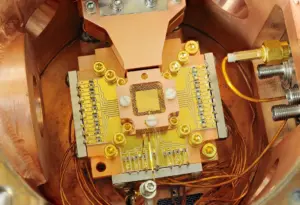
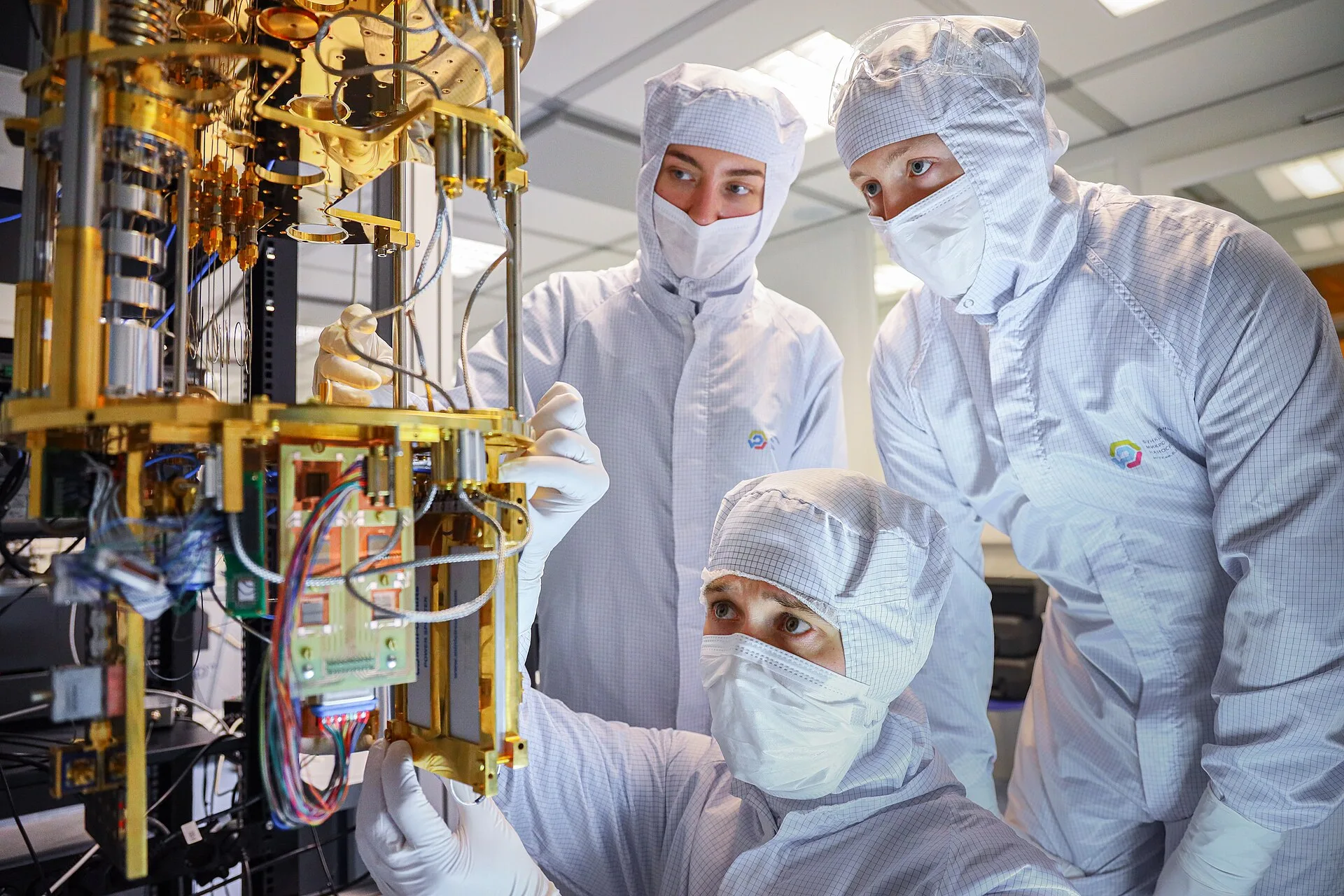
Rigetti makes superconducting quantum processors — aluminium circuits patterned on silicon, cooled to a few thousandths of a degree above absolute zero inside a dilution refrigerator, where they behave as artificial atoms. The company’s differentiator is chiplet-based scaling: rather than fabricating one enormous chip and accepting the yield penalty, Rigetti tiles smaller, higher-yielding dies together. It is the same economic logic AMD used to beat monolithic x86 designs, applied to qubits.
The numbers management publishes are unusually specific, which is to its credit. Cepheus-1-108Q currently operates at approximately 99.9% median single-qubit gate fidelity, approximately 99.1% median two-qubit gate fidelity, and roughly 60-nanosecond gate speeds. Step down in size and fidelity improves: 99.8% at nine qubits, 99.6% at 36. The roadmap targets systems of approximately 1,000 qubits at approximately 99.9% two-qubit fidelity with sub-50-nanosecond gates over roughly a three-year horizon.
That 99.1% figure at 108 qubits is the whole investment case in one number. Useful fault-tolerant computation needs two-qubit error rates in the 10⁻⁴ range or better; Rigetti is at about 10⁻². Closing that gap is what CEO Dr. Subodh Kulkarni has repeatedly identified as a coherence-time problem rather than a qubit-count problem — and coherence is a materials and fabrication challenge, which is precisely what the Commerce award funds.
Compare the trajectory with trapped ions: IonQ reported a 99.99% two-qubit gate fidelity record in 2025, two orders of magnitude better on error, at gate speeds a thousand times slower. Neither architecture has won. Anyone telling you otherwise is selling something.
Who is actually buying — HPE, the NSF, and India
Rigetti’s commercial base is small and almost entirely institutional, which is honest for the stage. In Q2 it expanded its collaboration with Hewlett Packard Enterprise and the Pittsburgh Supercomputing Center to develop a hybrid quantum-classical supercomputer, and agreed to deliver a nine-qubit Novera system to PSC’s new TangleLab testbed, funded by a National Science Foundation grant. It is fulfilling a 108-qubit system programme for C-DAC in India. Kulkarni’s framing in the results release: “Our recently announced expanded collaboration with Hewlett Packard Enterprise Company (HPE) and the Pittsburgh Supercomputing Center to develop a hybrid quantum-classical supercomputer reflects growing demand for our approach and positions Rigetti to deliver differentiated quantum-enhanced high-performance computing (HPC) solutions.”
On the award itself he was careful: the letter of intent “underscores the strategic importance of our platform and could help us accelerate key R&D programs aimed at scaling and advancing superconducting quantum computing.” Note the conditional. The three funded work packages are specific and unglamorous — compressing readout electronics into an integrated miniaturised package, expanding cryogenic capacity “by orders of magnitude” through a new cryostat architecture, and developing fabrication for high-connectivity chip architectures. Those are the actual bottlenecks in superconducting quantum computing, and nobody funds them speculatively.
What is missing from the customer list is a commercial enterprise buying quantum compute to solve a business problem at scale. Universities, national laboratories and government programmes are the buyers. Revenue of $5.1m in a quarter against a $5.34bn market capitalisation is the arithmetic consequence.
The valuation, and the number that should end most arguments
Rigetti trades at roughly 400 times trailing twelve-month revenue of $13.4m. Consensus for the full year is about $28.9m, putting the forward multiple near 184x. There is no defensible comparable. Nvidia at the peak of the 2024 AI melt-up traded in the mid-thirties on forward sales. The 2000-era optical networking bubble topped out around 100x. Rigetti is at nearly twice that, on a business that lost $28.1m at the operating line to produce $5.1m of revenue.
The counterargument is that revenue multiples are the wrong lens for a pre-commercial research company and that the right frame is cash, optionality and technical progress. Fair enough. On that frame: $541.3m of cash and investments, no debt, roughly $1.62 per share, a burn that ran $28.1m at the operating line in Q2, and a federal research partner. That supports a company. It does not obviously support $5.34bn.
| Scenario | Level | vs $15.99 spot | What has to be true |
|---|---|---|---|
| Bull | $30 | +87.6% | Both remaining Commerce tranches release on schedule; two-qubit fidelity at 108 qubits improves past 99.5%; the HPE-PSC hybrid system converts into repeat orders; quantum basket re-rates toward late-2025 levels |
| Base | $17 | +6.3% | 2026 revenue lands near $29m, the first milestone tranche releases, fidelity progress is incremental, and the stock keeps trading as a sector proxy |
| Bear | $8 | −50.0% | A milestone slips and a tranche is withheld, fidelity stalls on coherence, sector multiples compress, and the stock breaks its $12.53 March low toward five times cash |
Quick take: sell-side coverage is clustered right at the base-to-bull band — Cantor Fitzgerald carries Buy with a $30 target, Benchmark Buy at $25, and Wedbush initiated at Outperform. Nobody publishes the bear case, because nobody gets paid to. At $8 Rigetti would still trade at roughly 92x forward sales, which is worth sitting with: the bear case here is not a distressed valuation. It is a slightly less extreme one.
The policy structure, and what “equity stake” actually means
The Commerce Department’s quantum programme is the clearest example yet of US industrial policy moving from subsidy to ownership. The May 2026 framework committed $2.013bn across nine companies — Atom Computing, D-Wave, Infleqtion, PsiQuantum and Quantinuum at $100m each, Rigetti up to $100m, Diraq $38m, plus two foundries. By September, Rigetti, D-Wave and Quantinuum had converted letters of intent into signed agreements with equity attached.
The terms Rigetti disclosed are worth reading closely, because they are the template. Commerce covenants not to vote its shares except on changes to authorised share count, par value or the rights of common stock, and on any merger or business combination. Transfers are capped at the number of shares equivalent to amounts actually disbursed, and transfers to competitors in privately negotiated deals are prohibited. Commerce gets resale shelf and piggyback registration rights. And if the Department terminates the agreement, Rigetti can repurchase the undisbursed-equivalent shares for an aggregate of $1.00.
That last clause is the one that makes the structure defensible: the government’s stake is sized to the money it actually spends. But the tension is real. A research partner that is simultaneously a shareholder, a milestone judge with “sole discretion”, a creditor with clawback rights and a holder of march-in rights over the resulting intellectual property is a counterparty with unusual leverage. FinanceFeeds has tracked the same pattern in Nvidia’s equity positions across its own supply chain, including Intel — different sponsor, identical governance question.
What happens next: three predictions
1. The first milestone tranche is the next real catalyst, and it is a binary. The $29.9m second tranche releases only if Commerce is satisfied, at its sole discretion, that the relevant milestones were hit. Rigetti has not published the milestone dates. A disclosed tranche release would validate both the technology programme and the government relationship in one event; silence past the point the market expects one would do the reverse. Watch the 8-K filings, not the press releases.
2. Rigetti keeps trading as a sector proxy through 2026, and that is the bigger risk than any company-specific news. On 17 September Rigetti rose 8.11% on a day when IonQ published a research paper with Oak Ridge and NVIDIA. Rigetti announced nothing. D-Wave and Quantum Computing Inc. moved too. Four companies with wildly different architectures, revenue bases and government relationships are being traded as a single expression of a theme — the same pattern that governed junior lithium miners in 2022 and pre-revenue biotech in 2021. Sector-factor trading is fine on the way up. It is what makes the bear case a 50% move rather than a 20% one, because when the factor unwinds it does not stop to read the balance sheet. Our D-Wave price prediction and Quantum Computing Inc. analysis show how similarly the whole basket is priced relative to its fundamentals.
3. Fidelity, not qubit count, is the 2027 headline. Rigetti’s three-year target is ~1,000 qubits at ~99.9% two-qubit fidelity. The qubit number will arrive first and mean least; chiplet tiling makes count the easy variable. The fidelity number is gated on coherence time, which is gated on materials and fabrication — exactly the work the Commerce award funds, and exactly the work that does not respond to spending on a predictable schedule. Expect an announcement of a higher-count system before an announcement of materially better fidelity, and expect the market to reward the first far more than it deserves.
For the wider quantum-versus-classical picture, see our explainer on whether quantum computing can actually break Bitcoin.
FAQ
What is the Rigetti stock price prediction for 2026?
This analysis sets a bull case of $30, a base case of $17 and a bear case of $8 against the 17 September 2026 close of $15.99. Sell-side targets sit in the base-to-bull band: Cantor Fitzgerald at $30 with a Buy, Benchmark at $25 with a Buy, and Wedbush initiating at Outperform. The bear case would still leave Rigetti trading at roughly 92 times forward sales.
How much money did Rigetti actually receive from the CHIPS Act award?
$43.9 million was made available on or as soon as practicable after the 4 September 2026 award date. Two further tranches of $29.9 million and $26.2 million release only if the Commerce Department determines, at its sole discretion, that Rigetti has met the applicable milestones. Rigetti issued the Department the full $100 million of equity — 7,739,938 shares at an implied $12.92 — up front, though it can repurchase the undisbursed-equivalent portion for $1.00 in aggregate if Commerce terminates the agreement.
Does the US government control Rigetti?
No. The stake is roughly 2.3% of shares outstanding and the Securities Issuance Agreement contains a covenant that the Department will not vote its shares except on matters affecting the authorised share count, par value or rights of the common stock, and on mergers or similar business combinations. The Department does hold march-in rights over intellectual property developed with award funds, plus domestic-control, security and Davis-Bacon compliance obligations.
How much cash does Rigetti have?
$541.3 million in cash, cash equivalents and available-for-sale investments as of 30 June 2026, with no debt — approximately $1.62 per share. The operating loss was $28.1 million in the quarter, so the balance sheet funds several years of the current programme before counting any Commerce disbursements.
How does Rigetti compare with IonQ?
By revenue they are not close: IonQ’s trailing twelve-month revenue is about $246.5 million against Rigetti’s $13.4 million, roughly 18 to one. By market capitalisation the gap is about three to one ($16.0bn versus $5.34bn). Technologically they are different bets — Rigetti’s superconducting chips run gates in about 60 nanoseconds with ~99.1% two-qubit fidelity at 108 qubits, while IonQ’s trapped ions are far more accurate and far slower. Rigetti also has a federal equity partner; IonQ was not included in the Commerce awards.
What is Cepheus-1-108Q?
Rigetti’s current flagship superconducting system, built from tiled chiplets rather than a single monolithic die. It operates at approximately 99.9% median single-qubit gate fidelity, approximately 99.1% median two-qubit gate fidelity and roughly 60-nanosecond gate speeds. Smaller configurations perform better on error: 99.8% median two-qubit fidelity at nine qubits and 99.6% at 36 qubits.
This article is editorial analysis and market commentary, not investment advice. Scenario levels are FinanceFeeds estimates and are not price targets. Figures are as of the 17 September 2026 close unless stated otherwise.